
Peptide Structure vs Proteins: Key Differences Explained
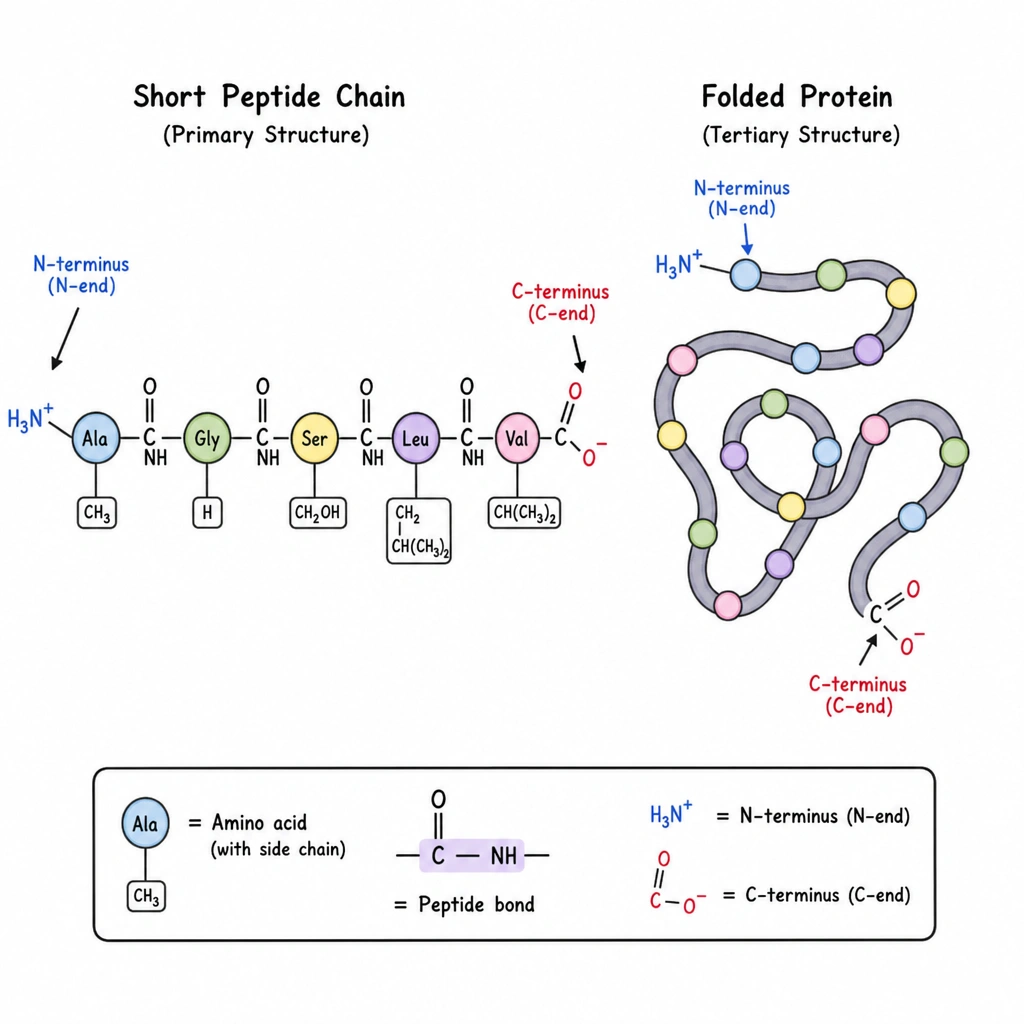
Peptides and proteins are both chains of amino acids linked by peptide bonds — the difference is mostly size and complexity. Peptides are short chains (roughly 2–50 amino acids); proteins are large, folded polymers of one or more long polypeptide chains. This guide breaks down amino-acid structure, how peptide bonds form, N- and C-terminus orientation, and exactly where the line between peptide, polypeptide, and protein is drawn.
Editorial & research disclaimer: This article is for educational purposes only. It explains the biochemistry of peptides and proteins and is not medical advice or product guidance.

Quick Answer
Peptide structure vs proteins: both are built from amino acids joined by peptide (amide) bonds, forming a backbone with an N-terminus at one end and a C-terminus at the other. The practical difference is scale: peptides are short (about 2–50 amino acids) and usually lack stable 3-D folding, while proteins are large (typically 50+ amino acids) and fold into defined three-dimensional shapes that determine their function.
In short: a peptide is the small, often un-folded chain; a protein is the large, folded, functional macromolecule. Many proteins are simply long polypeptides that have folded and, often, combined with others.
Same building blocks: both peptides and proteins are chains of amino acids linked by peptide bonds.
Size is the main divider: peptides ≈ 2–50 amino acids; proteins are larger (often 50+ and frequently hundreds).
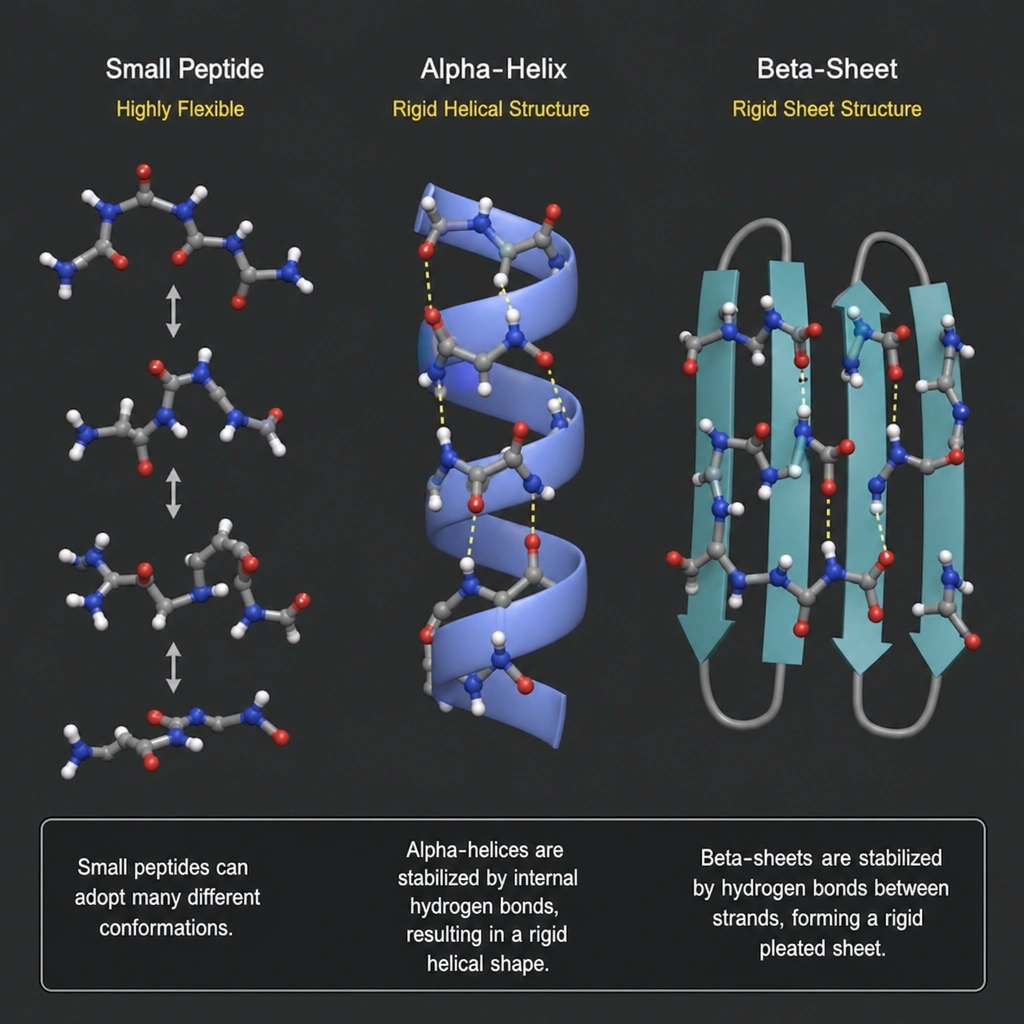
Structure differs: peptides are usually linear/flexible; proteins fold into defined 3-D shapes.
Direction matters: every chain runs from an N-terminus (free amino group) to a C-terminus (free carboxyl group).
The bond is an amide: a peptide bond forms when an amino group and a carboxyl group condense, releasing water.
The Building Blocks: Amino Acids
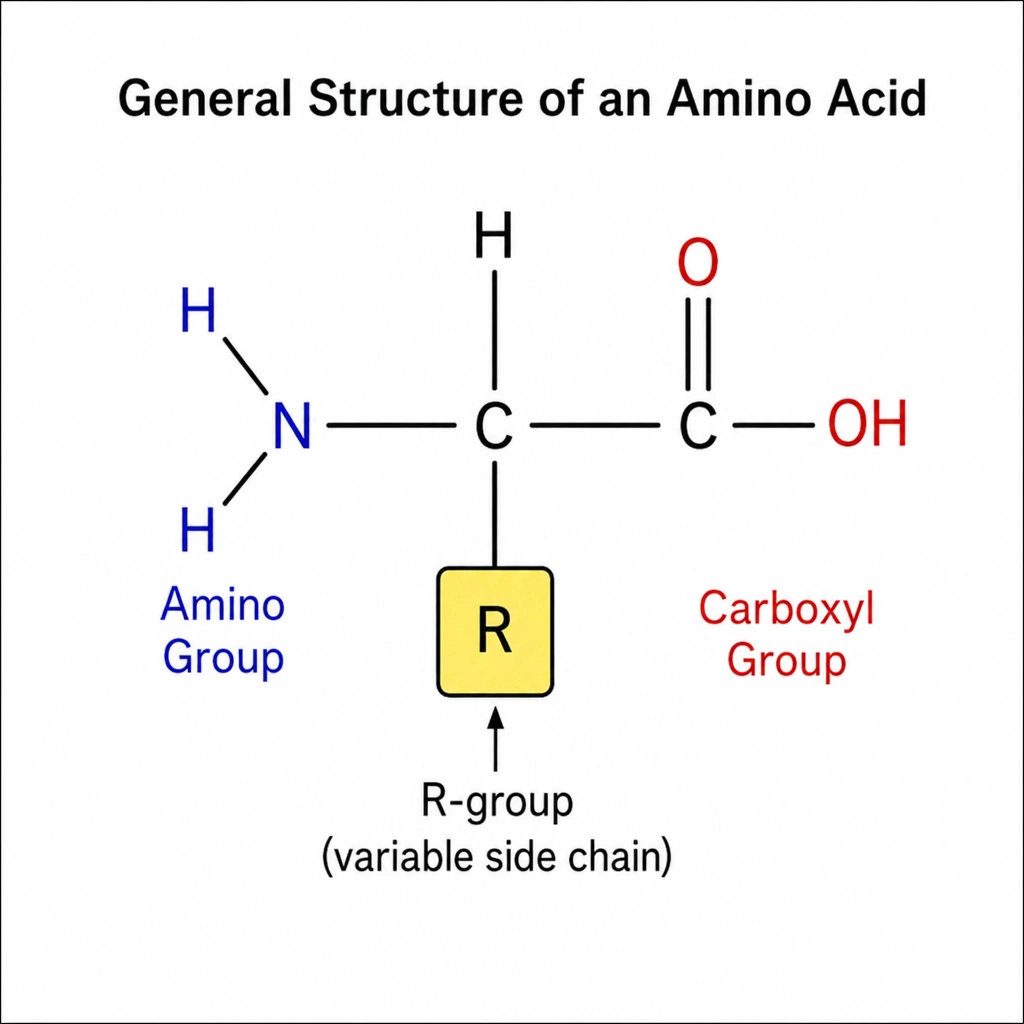
Every peptide and protein is assembled from amino acids, which are often referred to as residues once linked in a chain. Each amino acid shares a common core — a central carbon bonded to an amino group (–NH₂), a carboxyl group (–COOH), a hydrogen atom, and a variable side chain known as the R-group. Twenty standard amino acids appear in the genetic code, and it is the R-group that makes each one unique.
The R-group determines an amino acid's chemistry: whether it is hydrophobic or hydrophilic, acidic or basic, large or small. That single variable is what ultimately lets chains of amino acids fold into countless shapes, interact with specific receptors, and perform countless jobs.
What Is a Peptide? Understanding the Molecular Structure
A peptide is a short chain of amino acids linked together. Two amino acids form a dipeptide; three form a tripeptide; four form a tetra peptide; a handful form an oligopeptide like oxytocin; and longer chains are called polypeptides. The sequence — the exact order of amino acids, known as the primary structure — is the peptide's identity, much like letters spelling a specific word.
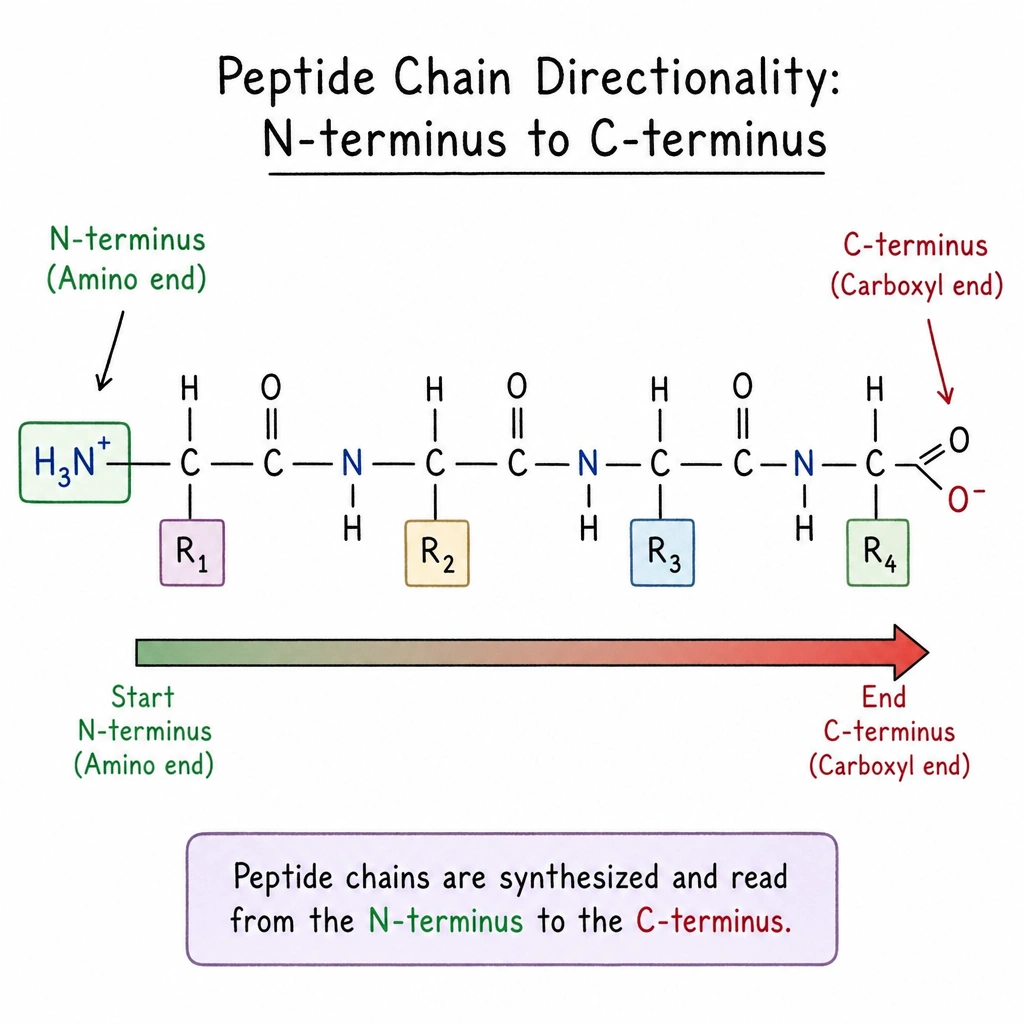
Peptides have a clear directionality. One end carries a free n-terminal amino group (the N-terminus) and the other a free c-terminal carboxyl group (the C-terminus). By convention, sequences are written and synthesized from N-terminus to C-terminus, which matters both for nomenclature and for how peptides are built in the lab.
The Chemistry of Connection: Peptide Bonds
Amino acids join through a peptide bond, a type of amide linkage. It forms by a condensation (dehydration) reaction in which the carboxyl group of one amino acid reacts with the amino group of the next, releasing a molecule of water.
- The carboxyl (–COOH) of amino acid one approaches the amino (–NH₂) of amino acid two.
- A hydroxyl from the carboxyl and a hydrogen from the amino group are removed as water (H₂O).
- A covalent C–N amide bond forms between the two amino acids, creating one of the strongest covalent bonds in biochemistry.
- The result is a dipeptide that still has a free N-terminus and C-terminus to extend further.
The peptide bond has partial double-bond character due to resonance, which makes it rigid and planar, though the overall chain remains subject to post-translational modifications like phosphorylation. That rigidity constrains how the backbone can rotate and is one of the foundations of higher-order protein folding.
From Dipeptides to Polypeptides: Size Matters
As chains grow, the vocabulary changes. Short chains are oligopeptides; longer ones are polypeptides, such as a peptide hormone or a neuropeptide; and once a polypeptide is long enough to fold into a stable functional structure, we call it a protein. The thresholds are conventional rather than absolute, which is why some molecules sit in a gray zone.
| Term | Approx. length | Notes |
|---|---|---|
| Dipeptide / tripeptide | 2–3 amino acids | Smallest defined chains |
| Oligopeptide | ~4–20 amino acids | Many signaling/cosmetic peptides |
| Polypeptide | ~20–50+ amino acids | Long chain, may or may not be folded |
| Protein | ~50+ amino acids (often hundreds) | Folded, functional macromolecule |
The Core Difference Between Peptides and Proteins
The cleanest way to summarize the distinction is across a few dimensions: size, structural complexity, and how they are typically made and used.
| Property (e.g., antimicrobial peptides) | Peptides | Proteins |
|---|---|---|
| Length | ~2–50 amino acids | ~50+ (often hundreds) |
| 3-D structure | Usually linear/flexible | Folded; defined secondary/tertiary/quaternary structure |
| Stability | Often shorter half-life | Generally more stable when folded |
| Function | Signaling, hormones, neuropeptide, antimicrobial, cosmetic | Enzymes, structure, transport, monoclonal antibodies |
| Synthesis | Solid-phase chemical synthesis common | Usually ribosomal / recombinant expression |
This is why peptides are attractive research and therapeutic tools: they are small enough to synthesize precisely and to act as targeted signaling molecules, while proteins carry out the large-scale structural and catalytic work of the cell. For a deeper primer, see PrymaLab's Research Hub.
Want to go deeper on peptide science?
PrymaLab's Research Hub breaks down peptide structure, synthesis, and sourcing for researchers and curious readers alike.
Visit the Research HubFrequently Asked Questions
What is the main difference between a peptide and a protein?
Both are chains of amino acids linked by peptide bonds; the difference is size and complexity. Peptides are short (about 2–50 amino acids) and usually linear, while proteins are large (typically 50+ amino acids), fold into defined three-dimensional shapes, and carry out structural or catalytic functions. The thresholds are conventional, not absolute.
What is a peptide bond?
A peptide bond is an amide linkage that joins two amino acids. It forms in a condensation reaction where the carboxyl group of one amino acid reacts with the amino group of another, releasing water. The bond has partial double-bond character from resonance, making it rigid and planar — a key factor in protein folding.
What are the N-terminus and C-terminus?
Every peptide chain or protein chain has direction. The N-terminus is the end with a free amino group (–NH₂); the C-terminus is the end with a free carboxyl group (–COOH). By convention, sequences are written and chemically synthesized from the N-terminus to the C-terminus.
How many amino acids make a protein instead of a peptide?
There is no hard cutoff, but a common convention treats chains up to about 50 amino acids as peptides and longer, folded chains as proteins. Function and folding matter as much as count: a protein is generally a polypeptide long enough to fold into a stable, functional 3-D structure.
What is the difference between an oligopeptide and a polypeptide?
Oligopeptides are short chains, roughly 4–20 amino acids, which includes many signaling and cosmetic peptides. Polypeptides are longer chains, around 20–50 or more amino acids. Once a polypeptide folds into a stable functional shape, it is usually called a protein.
Why does the R-group matter in amino acids?
The R-group (side chain) is the only part that differs between the 20 standard amino acids, and it sets each one's chemistry — hydrophobic or hydrophilic, acidic or basic, large or small. Those properties drive how a chain folds and interacts, which is why R-groups ultimately determine peptide and protein behavior, including their roles as neurotransmitters.
Are peptides easier to manufacture than proteins?
Often, yes. Short peptides can be built precisely by solid-phase chemical peptide synthesis one amino acid at a time, while large proteins are usually produced by ribosomal or recombinant expression in living cells. That manufacturability is part of why peptides are popular research and therapeutic tools, often serving as the basis for new peptide drugs.
Do peptides fold like proteins?
Generally not to the same degree. Short peptides tend to be flexible and lack the stable three-dimensional structures and secondary structure motifs, such as an alpha helix or beta sheet, tertiary structure, and quaternary structures, often stabilized by hydrogen bonding and disulfide bonds, that define proteins. Some longer peptides adopt partial structure, often through disulfide bridges, but defined, stable folding into a functional 3-D shape to perform complex biological functions, such as those seen in growth factors, is a hallmark of proteins.
References & Further Reading
- Nelson, D.L., & Cox, M.M. Lehninger Principles of Biochemistry (peptide bonds, protein structure chapters).
- Berg, J.M., Tymoczko, J.L., & Stryer, L. Biochemistry (amino acids and the peptide bond).
- IUPAC-IUBMB Joint Commission on Biochemical Nomenclature: peptide and polypeptide definitions.
- Lau, J.L., & Dunn, M.K. (2018). Therapeutic peptides: historical perspectives and trends. Bioorganic & Medicinal Chemistry, 26(10), 2700–2707.
PrymaLab resources: Research Hub · Research peptides · Peptide calculator · FAQ · About PrymaLab.
Final disclaimer: This article is an educational explainer about the biochemistry of peptides and proteins. It is not medical advice or product guidance, and nothing here is a recommendation to purchase, possess, or use any compound.
For any health decision, consult a licensed healthcare professional, and verify the legal status of any compound in your jurisdiction.